

Once you've identified your target leads, customize your content creation and use different types of content to promote your product or service. So your content strategy looks pretty solid, right?
The truth is, your content marketing efforts can and should always evolve.
Just as marketing strategy best practices change and adapt to current trends in consumer behavior, so does content marketing.
Your sales team has probably already created a sales funnel to get a better idea of what your target audience is thinking and doing at each stage of the buying journey.
You can also create a content marketing funnel to take your ideal customers from the awareness stage to the conversion stage where they become real customers.
In this article, we'll look at what a content marketing funnel is, how to create a successful content marketing funnel that converts, and what types of content should be included at each stage of the funnel.
What is a content marketing funnel?
The content marketing funnel allows content marketers to visualize how to use existing content to generate leads and guide them towards the end goal.
This end goal can include a sale, demo, download, or any other type of conversion.
Each stage of the funnel has a goal, such as attracting attention, generating quality leads, and completing conversions.
The marketing funnel can give brands more visibility into where their content may have gaps in the customer journey.
For example, if a brand has enough customer-facing content in the awareness stage but not enough content in the decision stage, they may want to redirect their efforts towards creating more content in the sales funnel.
How to start viewing a content funnel
First, you'll want to evaluate your current content inventory, including any type of content you create, whether it's blog content, detailed content (like ebooks or white papers), and so on.
As you look at each piece of content, you'll want to determine what stage of the buyer's journey that piece of content corresponds to. This phase will include:
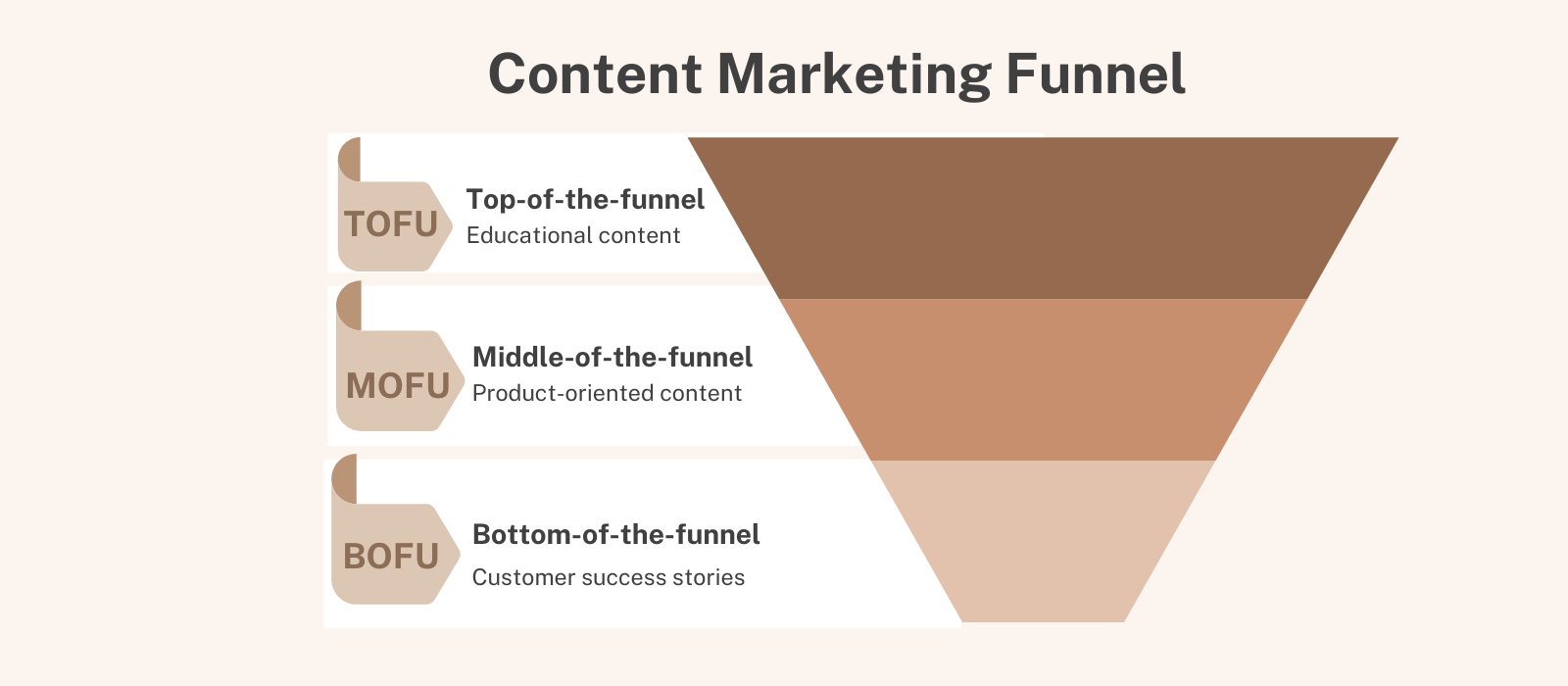
- Top of the funnel (TOFU) : awareness stage. In this stage, potential customers are looking for information.
- Mid-Funnel (MOFU) : stage of interest and consideration. In this stage, potential customers see your products or services and read customer reviews. They can present this information to key stakeholders.
- Bottom of the Funnel (BOFU): Intention, Evaluation and Conversion Stages. Buyers are willing to continue with their purchasing decision.
You can test each step individually, depending on where your target audience is and where they need different content.
Your content funnel can't be universal, otherwise you won't be able to effectively attract potential buyers. Relevant content should be presented at every stage of the funnel.
Let's take a look at the most effective content types for each stage of the funnel.
Top funnel content
At the top of the funnel, customers collect information that helps them navigate the buyer's journey.
At this stage, the customer is most likely to learn about your business and what you have to offer.
This is where you want to create a positive customer experience to show the buyer that you are more engaged.
You'll want to answer their questions, tell them about their concerns, and turn those leads into interesting leads.
A study by Semrush found that the following TOFU content types are best for driving traffic.
- How to drive (72%).
- Landing page (35%).
- Infographics (28%).
- Checklist (27%).
- e-books/white papers (26%).
- Video tutorials (23%).
As you can see, most of this type of content is educational content designed to bring information to a higher level of awareness.
The primary purpose of your content at this stage is to help, and it shouldn't be overly commercial.
The content of the central part of the sequence
Once your ideal customers reach the middle of the funnel, they stop looking for superficial introductory content.
Instead, you'll want to create content that will move your prospects further down the sales funnel. They might be looking for customer reviews, product reviews, or training videos.
Looking at the results of the same Semrush study, the following MOFU content types perform best when driving traffic.
- Practical guide (44%).
- Product presentation (40%).
- Case studies (34%).
- Landing pages (31%).
- Webinars (31%).
- Success Stories (30%)
Keep in mind that these prospects are most likely familiar with your brand during the discovery phase and therefore shouldn't receive content during the discovery phase. An effective content strategy tailors content for your audience.
In fact, research shows that 71% of consumers expect businesses to have a personalized experience and 76% are disappointed when they don't.
If you don't tailor your content plan and content marketing formats to your customers at every stage, you risk creating a bad experience with your business.
Contained at the bottom of the funnel
Once a prospect reaches the bottom of the funnel, they look for content to help them make a final purchasing decision.
They want to know how your product or service will increase their ROI and why you are better than your competitors.
Since these customers are past the awareness stage and are potentially looking to convert, the type of content you present to them is key to building trust and ultimately making a purchase.
The content you submit during the review phase can be the difference between a conversion and a lost sale. The most effective content types in the BOFU category include:
- Brief description of the product.
- Customer reviews.
- Progress.
Consider sharing success stories with current customers who are similar to your prospects at this stage of the funnel.
Other examples of content included in this stage are email campaigns that include positive customer reviews and product warranties. Also include special offers, free trials or live demos.
What to do after rating your content
Once you have an overview of the content that already exists at each stage of the journey, it's time to identify where you have gaps.
You will also need to determine the type of content items you want to create. For example, you may have determined that you don't have content for buyers in the fame stage. Or maybe you don't have enough customer success stories.
Once you've identified content gaps, it's time to create an editorial calendar to prioritize what to address first and when.
Your editorial calendar should be monitored daily to keep track of what's in your queue, what's coming in, the article's intended content audience, and where the article is in the content marketing funnel.
It can also be helpful to conduct a competitive analysis of your competitor's marketing strategy to identify opportunities for more new content and how you can improve your content.
You want relevant and useful content that meets Google's useful content system standards and provides the best user experience.
closure
A comprehensive and integrated content strategy is the key to creating an enjoyable shopping experience. Keep your audience in the spotlight as you create each piece of content.
You'll also need to have a deep understanding of your target customers, how they think they're looking for, and how you can solve their problems.
Perfecting an effective content marketing funnel takes time, experimentation, and patience, but it's absolutely necessary to outperform the competition and stand out.
Additional Resources:
Featured image: Vitaly Vodolazsky/Shutterstock